Pool State Pages: The Five Numbers to Check Weekly
A pool state page can show twenty figures and still leave a miner unable to answer one question: did this week pay what it should have? Five numbers settle it — your own hashrate, the pool's hashrate, the network hashrate that difficulty implies, the difficulty and its next adjustment estimate, and the BTC actually credited. At 1 PH/s the credited figure should land near 0.00047353 BTC a day, about $40.39 at $85,294 per BTC.

Key takeaways
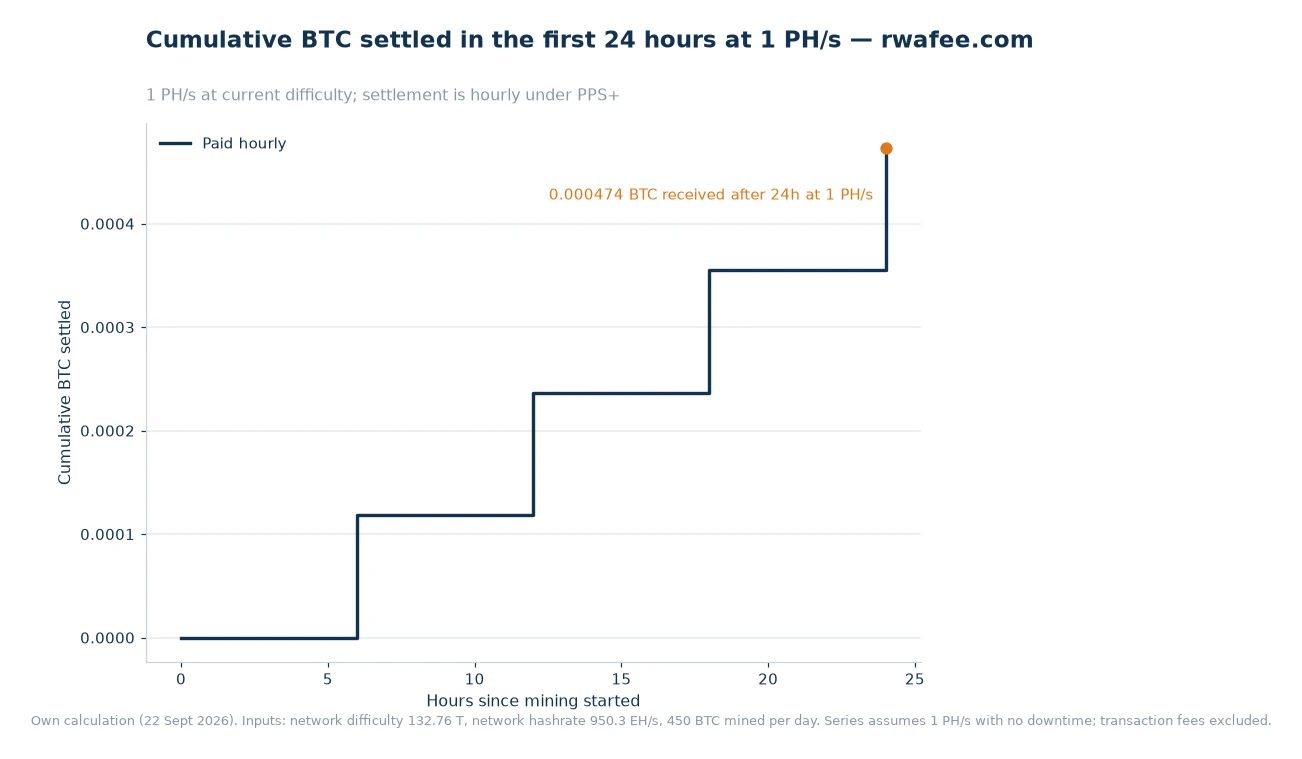
- The five numbers are checked against one benchmark: 1 PH/s expects 0.00001973 BTC an hour, so a 24-hour total near 0.00047353 BTC means the week started clean.
- Difficulty is the number miners most often forget; the current estimate for the next retarget is +1.90%, which moves every future share value.
- Pool Luck belongs beside pool hashrate rather than beside your balance, because it describes the pool's block timing, not your settlement.
- A weekly gap of a few percent is arithmetic; a gap that persists across three weekly readings is a fault with a date attached to it.
Reading one: your own hashrate
Start with what you are actually submitting, not with what the nameplate says. A 1 PH/s fleet that reports 0.94 PH/s is 6% below expectation before any other variable enters, which is about $2.42 a day at $0.0404 per TH/s per day. Compare per worker where the interface allows it, because a fleet average of five machines hides one that has been throttling since a firmware update.
The consistency check is simple: multiply reported TH/s by 0.0000004735 BTC to get the expected daily figure. At 1000 TH/s that returns 0.00047353 BTC, and dividing by 24 gives the hourly benchmark of 0.00001973 BTC — close to $1.68 at the price above.
Reading two and three: pool hashrate and network hashrate
The pool's hashrate matters because it sets how many blocks the pool expects to find, which in turn decides how a PPLNS miner's distributions are spaced. The network hashrate matters because it sets the value of each share. Difficulty of 132.76 T implies 950.3 EH/s, and 144 blocks a day at 3.125 BTC puts 450 BTC into the network daily, about $38,382,300.
Divide the second number by the third and you have the pool's share of the chain, the ratio that makes Pool Luck and block spacing interpretable. A pool with a small share will always show dramatic short-window luck numbers; the same pool's 30-day figure is the one worth quoting.
Reading four: difficulty and the next estimate
Difficulty is the denominator of every earnings figure you have. A +1.90% estimate for the coming retarget means your daily BTC at unchanged hashrate falls by about 1.9% when it lands — on a 1 PH/s fleet, from 0.00047353 to roughly 0.00046451 BTC a day, or about $2 lower per month on that hashrate alone. Watching the estimate weekly means the drop is expected rather than alarming.
| Number | Benchmark | What a change points at |
|---|---|---|
| Your hashrate | 1 PH/s reported, near 0.0404 USD per TH/s per day | A throttling or offline worker inside the fleet |
| Pool hashrate | Stable week over week, look for steps not slopes | Operators joining or leaving; relevant to PPLNS spacing |
| Network hashrate | 950.3 EH/s implied by 132.76 T difficulty | A network-wide efficiency shift, not your problem |
| Difficulty estimate | +1.90% expected at the next retarget | A predictable change in every future share value |
| BTC credited | 0.00001973 BTC per hour, 0.00047353 per day | Uptime, fees, or a settlement state you misread |
Reading five: BTC credited
Credited value is the only number that is yours. Under PPS+ the block-reward component is settled per accepted share at current difficulty and paid hourly, which makes the hourly benchmark directly checkable: 0.00001973 BTC at 1 PH/s, near $1.68. Weekly, that is 0.00331471 BTC, about $282.71 gross, and $1,163 of net value a month once the listed 4% fee on that component is applied.
Read it in the right window. Comparing a single hour against the benchmark will produce false alarms as share variance does its work; comparing a week against seven days of the benchmark will not. Two readings that agree within a few percent is a healthy account, whatever the dashboard's live gauge happens to say at that moment.
Worked example: one weekly review at 1 PH/s
The fleet reports 1 PH/s, which against 950.3 EH/s is a network share of 1.05 × 10⁻⁶. Network issuance is 450 BTC a day, so the expected daily credit is 0.00047353 BTC. Divided by 24 that is 0.00001973 BTC an hour; multiplied by seven it is 0.00331471 BTC a week, worth about $282.71 gross. A 30-day month at the same rate is 0.014206 BTC, near $1,211.68.
Now check the delivered number against that. If the week credited 0.00315 BTC, the shortfall is 0.00016471 BTC, about $14 — and the five readings tell you where it came from. Fleet hashrate below 1 PH/s explains it as uptime. Fleet hashrate at 1 PH/s with a thin fee component explains it as PPLNS timing on the 2% slice. Neither explains it, and the difficulty estimate was clean, and the gap is a settlement question rather than a mining one.
Where to read the five numbers together
Use one page for the check rather than three tabs. The state view lists ViaBTC Pool Hashrate next to network hashrate and difficulty, which is where the ratio and the estimate can be read in one pass. The wider pool statistics pages add miner counts and longer output history, useful when you want to know whether a movement is one operator or many.
Keep the review to fifteen minutes and do it on the same weekday. A weekly habit produces three comparable readings a month and enough evidence to tell a trend from a wobble; an improvised check produces whichever reading you happened to catch. Fifteen minutes a week is about an hour a month, and that hour is what separates a payout question you can answer from one you can only describe.
Frequently asked questions
Which of the five numbers matters most?
Your own reported hashrate, because it is the only one you can fix. At 1 PH/s, a 6% shortfall is roughly $2.42 a day, and it will keep costing that every day until someone walks to the rack.
How often should difficulty be checked?
Weekly, which aligns with the roughly two-week retarget cycle and gives you at least one reading before the estimate changes. Recompute expected BTC after each adjustment rather than carrying an old benchmark forward.
Is a PPLNS pool harder to review weekly?
Yes, because distributions arrive when blocks are found and confirmed, so a quiet week looks like a gap rather than a lower rate. Read the 30-day figures for structure and your own hashrate for faults, and treat the weekly total under PPLNS as informative rather than definitive.
Fifteen minutes, five numbers, one weekday
Put the five readings in a single note every week: hashrate, pool hashrate, network hashrate, difficulty estimate, BTC credited. Add the expected 0.00001973 BTC an hour beside the credited figure so the comparison is arithmetic rather than judgement. Three weeks of that note will tell you more about your operation than any live dashboard, and it costs about fifteen minutes a week.
Data and sources: ViaBTC fee schedule[1], pool statistics pages[2] and the miner profitability reference[3]. Network difficulty 132.76 T, implied network hashrate 950.3 EH/s, the 3.125 BTC block subsidy, 144 blocks per day, an estimated next adjustment of +1.90% and a BTC price of $85,294 were read from public chain data and market feeds; read 22 Sept 2026. All figures are arithmetic on those inputs and change with difficulty, price and uptime.