Bitcoin Pool Data: Hashes, Luck and the 445-Day Target
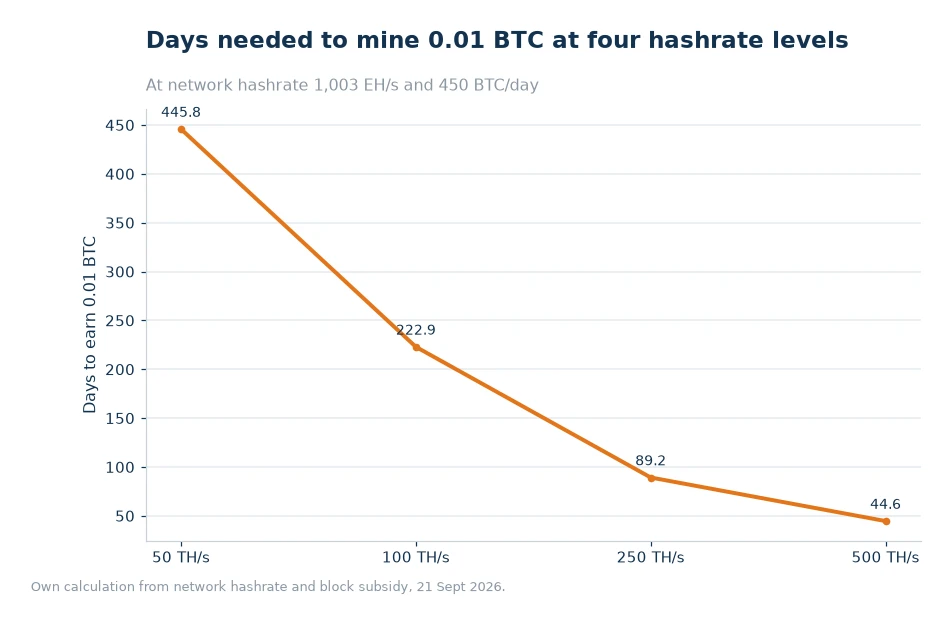
A pool page is a set of measurements about a group, and most miners read it as if it were about themselves. The group numbers explain why a week was quiet; your own hashrate explains the days to a target. At 50 TH/s, 0.01 BTC takes 445.8 days, and no amount of pool detail changes that arithmetic.

Key takeaways
- 0.01 BTC takes 445.8 days at 50 TH/s and 44.6 days at 500 TH/s.
- Pool Hashrate describes the group's size; Pool Luck compares blocks found with blocks expected.
- Neither figure changes your per-terahash rate, but both explain a short week.
- PPS+ settles the block-reward component hourly at a listed 4%; PPLNS pays after six confirmations at a listed 2%.
Two readings that frame the rest
The first number is the total hash the pool is working with. It sets how often blocks arrive for the group as a whole, and it is the figure that determines whether settlement feels continuous or arrives in bursts. The second is the ratio of blocks found to blocks expected over a window, which is what miners usually mean when they say a pool is running hot or cold.
The ViaBTC BTC Mining Pool page shows both, and the pairing is deliberate: size without luck tells you how noisy the payout series should be, while luck without size has no context. A pool with 1% of the network and 130% Pool Luck had a good fortnight; a pool with 20% of the network and 99% Pool Luck is simply behaving.
Neither reading is a forecast. Luck reverts toward 100% over enough blocks, which is why a pool that is 20% behind expectation this week is not owed a windfall next week. The ratio is a description of what already happened, and treating it as a prediction is the most common misreading of the page.
The target in days, at four hashrates
The table keeps 0.01 BTC fixed and uses 450 BTC a day across a 1,003 EH/s network, or 0.00000044865 BTC per TH/s per day. Gross dollars use $84,692 per BTC.
| Hashrate | Daily BTC | Days to 0.01 BTC | Gross USD/day |
|---|---|---|---|
| 50 TH/s | 0.000022433 | 445.8 | $1.90 |
| 100 TH/s | 0.000044865 | 222.9 | $3.80 |
| 250 TH/s | 0.00011216 | 89.2 | $9.50 |
| 500 TH/s | 0.00022433 | 44.6 | $19.00 |
The 50 TH/s row is the awkward one. At $1.90 a day gross, a machine drawing 900 watts at $0.08 per kWh spends $1.73 on power, leaving 17 cents before any fee. The target is reachable in 445.8 days on paper and much less reachable in practice, because a single unplanned outage or a small difficulty rise removes the margin entirely.
Worked example
Take 100 TH/s, the middle of the useful range, and walk the arithmetic.
- 450 BTC a day ÷ 1,003,000,000 TH/s = 0.00000044865 BTC per TH/s per day.
- 100 TH/s × 0.00000044865 = 0.000044865 BTC a day.
- 0.01 BTC ÷ 0.000044865 = 222.9 days.
- 222.9 × 24 = 5,349.6 hours of running.
- Gross value: 222.9 × $3.80 = $847.02, which matches 0.01 × 84,692 = $846.92 to rounding.
- At 50 TH/s the daily credit halves to 0.000022433 BTC and the target doubles to 445.8 days.
- At 250 TH/s: 0.01 ÷ 0.00011216 = 89.2 days; at 500 TH/s: 0.01 ÷ 0.00022433 = 44.6 days.
- The 4% listed rate on the block-reward component would take $12.60 off a 445.8-day run at 50 TH/s, which is smaller than a fortnight of power.
Why luck matters more at some sizes
The variance in block discovery scales with the inverse of the pool's share of the network. A large pool finds many blocks a day, so its short-term luck ratio is stable and its payout series is smooth. A small pool finds few, so a single block moves the ratio by tens of percentage points, and the miner's PPLNS income moves with it.
This is the part of the pool page that actually changes a decision. A miner who needs a predictable monthly credit should prefer a pool whose block frequency is high enough that a bad week is a rounding error. A miner with cheap power and a long horizon can accept more variance in exchange for a lower listed rate, which is the trade PPLNS offers.
Payout mode as a variance dial
PPS+ is the default. The block-reward component settles hourly against current difficulty, with a listed 4% on that component and 2% on the transaction-fee part. The miner does not carry pool luck or orphan risk on the block reward, which is exactly why the listed rate is higher there than under the alternative.
PPLNS applies a listed 2% to the combined block reward and transaction fees, pays after six confirmations, and measures the miner's slice over the last five difficulty rounds. The lower listed rate is compensation for carrying the variance. Over a long enough window the two converge; over a month they can differ by more than the fee gap.
What the page does not tell you
It does not tell you your uptime, your power rate or the age of your hardware. Those three determine whether the days column is achievable, and none of them appear on a pool dashboard. A miner who reads the page carefully and ignores the power contract has optimised the wrong variable.
It also does not tell you the future difficulty. The estimate read on 21 Sept 2026 pointed to a 2.12% reduction, which would shorten a 445.8-day target by roughly nine days if it held. Nine days is smaller than the uncertainty in most mining plans, and worth remembering the next time a projection lands on an exact date.
Comparing two pools without guessing
Four numbers make a fair comparison: the listed rate on the component that dominates your income, the pool's share of the network, the settlement timing, and the fee treatment of transaction fees. Write them in a row for each pool and the choice becomes arithmetic rather than reputation. Anything not in that row is a preference, which is fine, as long as it is labelled as one.
Check the numbers again after a difficulty change, because a pool's share moves and so does the value of a fixed hashrate. The comparison that was right in September may be wrong in November, and the only way to know is to redo four lines of arithmetic. Keep the four lines in the same note as the payout address, so the review takes a minute rather than an evening.
Frequently asked questions
How long does 0.01 BTC take at 250 TH/s?
About 89.2 days at a 1,003 EH/s network, because 250 TH/s earns 0.00011216 BTC a day before fees and the target is one hundredth of a coin.
Does high Pool Luck mean a pool will pay more?
No. Luck describes blocks already found against blocks expected, and it reverts toward 100% over enough blocks, so a high reading is a description rather than a forecast of future payouts.
Should a small miner choose PPS+ or PPLNS?
PPS+ suits a fixed monthly power bill because the block-reward component settles hourly at a listed 4%; PPLNS offers a listed 2% on the combined reward and fees but leaves the miner carrying the variance.
Read the group, then check your own row
Start with the group: how big is the pool, and is its luck near the expected line? Then move to your own row in the table and decide whether the days figure is acceptable at your power rate. The first step explains the shape of the payouts; the second decides whether the machine should be running at all.
The Statistics page carries the network-side figures that sit behind the table, and the fee schedule states the listed rates component by component. Read them together once a month, and the pool page stops being a scoreboard and starts being a tool.
Sources: the ViaBTC state, statistics and pricing pages, with chain data read 21 Sept 2026[1]. Network hashrate 1,003 EH/s, difficulty 132.76 T, 3.125 BTC per block, 144 blocks a day, BTC $84,692. Published 22 Oct 2026; day counts assume continuous uptime and a steady difficulty.