Pre-production and during-production checks serve different purposes. Readiness review confirms that approved inputs, materials, tooling, instructions, and controls are in place; production checks verify that actual work follows the plan and emerging issues are contained. Both should be scheduled around the point where a finding can still prevent a larger defect or missed shipment.
Key takeaways
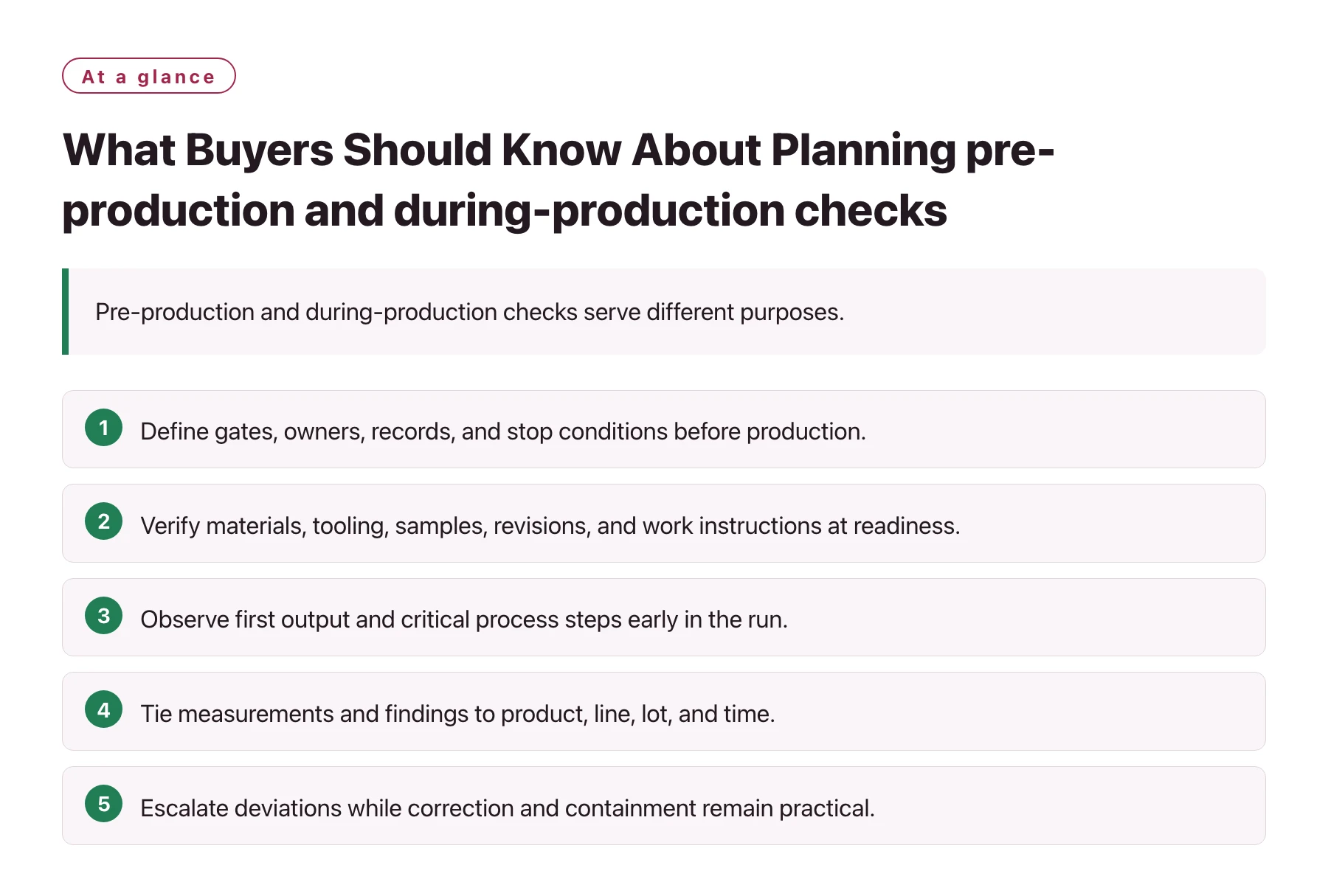
- Define gates, owners, records, and stop conditions before production.
- Verify materials, tooling, samples, revisions, and work instructions at readiness.
- Observe first output and critical process steps early in the run.
- Tie measurements and findings to product, line, lot, and time.
- Escalate deviations while correction and containment remain practical.
The value of an early check depends on access to the right inputs and a clear route from finding to corrective action.
1. Set the objective and control points
Decide which risks require verification before production begins and which can only be observed once work is underway. Identify product characteristics, process steps, materials, tooling, labels, packaging, and documents that could cause costly rework or unsafe output if wrong.
Create a plan with checkpoint, responsible owner, timing, evidence, acceptance criteria, escalation contact, and hold condition. Coordinate checks with real production milestones rather than choosing dates that may occur before goods or records are available.
2. Verify the approved specification and change status
Confirm current drawings, bills of materials, process instructions, test methods, packaging, and acceptance criteria are issued to the factory. Remove obsolete revisions from the work area. Identify approved deviations and their affected orders or lots.
Ask how the supplier communicates changes to operators, inspectors, and subcontractors. A drawing may be correct in procurement files while the production line still follows an old copy. Trace the revision through the actual work instruction and first output record.
3. Review material and component readiness
Check material identification, supplier, grade or model, certificates where required, lot numbers, storage condition, and incoming acceptance. Compare items to the bill of materials and approved sample. Identify missing, substituted, expired, damaged, or unverified components before line setup.
For critical inputs, trace a sample from receipt through storage and issue to production. Confirm how mixed lots are segregated and how rejected material is prevented from entering the line. Material availability alone does not establish conformity.
4. Confirm tooling, equipment, and work instructions
Check that tooling, fixtures, gauges, machines, and test equipment match the approved process and are ready for use. Review maintenance or calibration status where measurement reliability affects acceptance. Ask who can adjust process settings and how changes are recorded.
Observe whether current instructions are accessible and understandable to operators. Verify training or qualification for tasks with special requirements. For automated or outsourced processes, identify the evidence showing the process was set up and validated for the product being made.
5. Align the first production output
Define how much first-off or initial output is produced before broader production continues. Inspect or test the characteristics most likely to reveal setup, material, or interpretation errors. Compare output against the approved sample and specification using documented methods.
Record machine or line, operator, time, materials, revision, measurements, observations, and disposition. If a first-off fails, contain output produced since the last known good point and document who approves restart. Do not rely on a verbal “adjusted” status without rechecking.
6. Select during-production observation points
Choose process stages where defects are created or become harder to detect later. Examples may include forming, sewing, coating, assembly, soldering, sealing, labeling, or packaging, depending on the product. Define the observation window, sample basis, test, and record.
A check should distinguish actual process evidence from a demonstration set prepared for visitors. Observe normal operators and production conditions when possible. Note idle lines, bypassed steps, rework queues, mixed work-in-progress, and other conditions that affect representativeness.
7. Set measurements, sampling, and records
For each checkpoint, specify characteristic, method, units, instruments, sample selection, frequency, and acceptance. Use qualified expertise for specialized safety, material, or performance tests. Ensure inspectors and factory staff interpret criteria consistently.
ISO 9001 describes quality management system requirements including process control and documented information. Certification does not prove every production run conforms; review records and product evidence for the current order, site, revision, and lot. [1]
8. Contain findings and manage corrective action
When a deviation appears, identify the affected period, quantity, materials, stations, and related lots. Separate good, suspect, and rejected output. Stop or limit the process when required by the agreed risk and hold rules. Notify the named buyer owner promptly.
Require root-cause analysis, correction, corrective action, owner, due date, and verification. Record whether the action changes process settings, tooling, instructions, or inspection frequency. Restart only under the assigned authority and confirm that corrected output meets the approved criteria.
9. Connect checkpoints to final inspection and release
Early checks reduce risk but do not automatically replace final inspection, required tests, document review, or buyer release. Define what evidence flows forward and which characteristics still need final verification. Ensure the final lot identity includes production dates and any relevant process changes.
If a supplier changes material, equipment, site, subcontractor, or revision after an early check, decide whether the affected checkpoint must be repeated. Shipment should not proceed with critical findings open or required records missing.
10. Review whether the checkpoints prevented recurrence
After completion, compare early findings with final inspection, receiving defects, complaints, and rework. Assess whether the check occurred early enough, used a representative sample, and produced a clear owner response. Update the plan when evidence shows a control was late, weak, or unnecessary.
Buyers planning product quality checks in China can align readiness review, first-off approval, in-process observations, and shipment release with a single evidence trail. Keep lessons linked to supplier, site, product, revision, and process so future orders inherit relevant controls.
Sources
Frequently asked questions
What is the difference between readiness and in-process checks?
Readiness checks inputs and setup before production; in-process checks observe actual work as it proceeds.
Should production stop after every minor finding?
Use predefined risk and hold criteria; contain affected output and escalate according to the potential impact.
Do early checks replace final inspection?
Not automatically. Retain final checks required by the product specification, risk plan, and contract.
What makes a first-off result useful?
It is tied to the current setup, revision, material, method, measurements, and an authorized disposition.