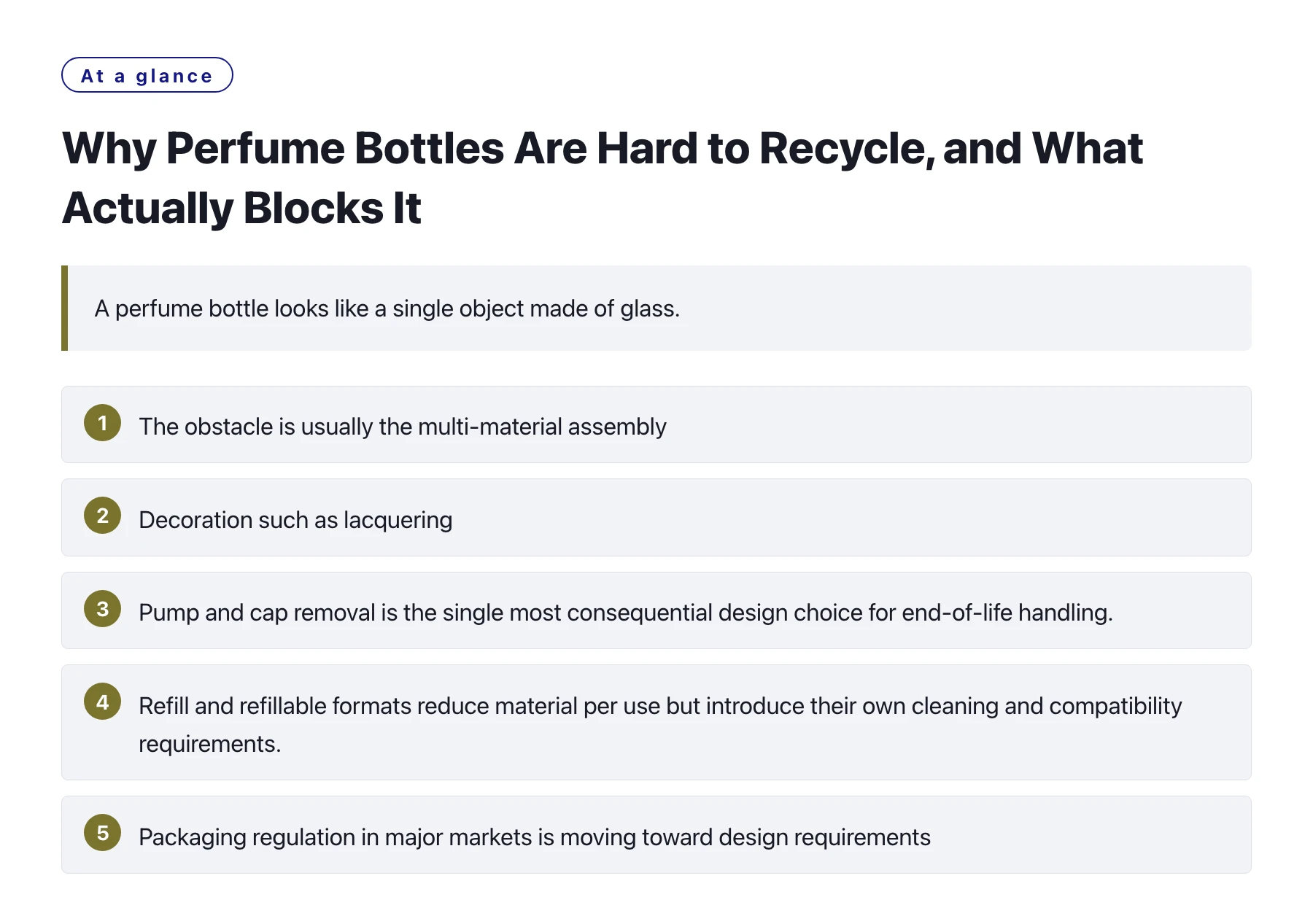
A perfume bottle looks like a single object made of glass. In practice it is a container, a coating, an adhesive, a pump and a cap, sometimes from five different material families and bonded together so that separating them costs more than the materials are worth. That assembly is the recyclability problem, and it is decided at the design stage rather than at the waste bin.
Key takeaways
- The obstacle is usually the multi-material assembly, not the glass itself, which is widely recycled where collection exists.
- Decoration such as lacquering, metallisation and hot stamping can disqualify an otherwise recyclable glass container.
- Pump and cap removal is the single most consequential design choice for end-of-life handling.
- Refill and refillable formats reduce material per use but introduce their own cleaning and compatibility requirements.
- Packaging regulation in major markets is moving toward design requirements, so decisions made now will be assessed later.
Brands rarely set out to make packaging that cannot be recycled. They set out to make packaging that looks a certain way, feels heavy enough to signal quality, survives transport and carries a pump that works. Recyclability is the last requirement added and the easiest to compromise.
The result is a familiar object: glass coated in lacquer, a metal collar bonded on, a plastic pump with a metal spring, and a cap lined or weighted. Each part is defensible on its own, and the combination is what makes recovery difficult.
This article separates the real blockers from the marketing language, orders them by how much they matter, and sets out the decisions a brand can actually influence.
Where recyclability is actually lost
Recycling systems sort materials by family and process them separately. A design that mixes families in a way that cannot be separated cheaply arrives at the sorting stage and leaves it as residue. The packaging was not refused for being glass or plastic; it was refused for being both at once.
This is why the useful conversation is not about whether a bottle is recyclable as a material, but about whether the finished pack can be separated into streams by whoever handles it. That question has roughly four answers, and they are ranked below by how often they decide the outcome.
The decoration decides more than the base material
Lacquering, metallisation, ceramic-effect coatings and full-wrap hot stamping all change how a glass container is processed, and some of them make it unacceptable to glass recyclers. A clear glass bottle with no coating is straightforward; the same bottle with a metallic spray finish may not be.
Decoration is also the part brands are least willing to change, because it is what the consumer sees. That tension is the real negotiation in a sustainable packaging project.
Pumps, collars and caps
A pump typically contains several polymers plus a metal spring, and it is bonded or crimped to the bottle neck. If it cannot be removed by hand or in the handling process, the glass stream is contaminated by it.
Designs that allow the consumer to unscrew and separate the pump, or that use a single-material closure, materially change the end-of-life outcome. It is a small change with an outsized effect, and it is decided in the drawing rather than in the factory.
Weight and size cut both ways
Heavier glass signals premium quality and is often easier to recycle, because it is a larger share of the pack and attracts recovery interest. Small formats, on the other hand, are frequently lost in sorting because they fall through screens or are too light to be captured.
So a lighter bottle is not automatically the greener choice. Material reduction helps in production but can reduce recovery, and the two effects have to be weighed for the specific market and collection system.
Common blockers, ranked by how much they decide the outcome
| Blocker | Why it matters | Design alternatives | What it costs you |
|---|---|---|---|
| Bonded pump and collar | Prevents separation into glass and plastic streams | Unscrewable pump, single-material closure, or a refillable inner vessel | Slight change to the silhouette and a higher unit assembly cost |
| Metallised or lacquered finish | Can make the container unacceptable to glass processors | Tinted glass, sandblasted glass, or a decoration on the outer carton instead | Visual effects that a coating gives more cheaply than the glass itself |
| Multi-layer or weighted bases | Mixes materials in a way that cannot be separated | Solid glass base, or a separate outer shell in a single material | Weight and perceived solidity in the hand |
| Adhesive-lined labels | Residue interferes with processing even when the label lifts | Water-soluble adhesive or moulded-in branding | Some print finishes and fine detail |
| Very small travel formats | Lost in sorting before they reach a processing stream | Refillable outer case with a smaller inner vessel | Higher upfront tooling and a more complex consumer routine |
Work down the table rather than across it. Fixing the first row changes more than fixing the last two, and it is usually the cheapest of the five to address.
Refills, regulation and the direction of travel
Refill and refillable formats are the most visible response to packaging waste, and they are genuinely effective at reducing material per use. They are not automatically better in every respect: a refill requires a container that survives repeated use, a filling route that works for the consumer, and a compatible inner vessel.
Packaging policy is also moving. In the European Union, packaging waste rules are being revised to place more emphasis on design, reuse and recyclability, which means packaging placed on the market now will increasingly be assessed against requirements that did not exist when it was drawn [1]. Industry coalitions working on material and design guidance publish detailed positions on how to interpret those requirements in practice [2].
What a refill system really demands
A refill has to be filled without spilling, sealed without leaking, transported without breaking and used without instructions longer than a sentence. Those are engineering constraints, and they are the reason refill projects take longer than they look.
The outer case also has to survive handling, which pushes material choice toward more durable options that may themselves be harder to recycle. The trade-off is real and should be stated rather than assumed away.
Chemical and material questions sit alongside the design ones
Packaging interacts with its contents. Plastics can absorb fragrance materials and glass can be affected by coatings, so compatibility work is part of the sustainability project rather than separate from it. Wider work on chemicals and pollution policy sets the context in which these material choices are judged [3].
Test the intended pack with the intended formula for the full shelf life before committing to a decoration or a material change.
Get the questions into the design brief
Recyclability is easiest to influence in the first drawing and most expensive to retrofit later. Put the requirement into the packaging brief at the same time as the aesthetic direction, and name who is responsible for confirming it.
Suppliers that handle both the fragrance and the pack, such as Xuelei Cosmetics, can usually flag material conflicts between the two at the sampling stage rather than after tooling. Regardless of supplier, ask which of the blockers in the table above apply to your design and what the alternatives would cost.
Beware of a sustainability claim that rests on a material rather than on a system. Glass is described as infinitely recyclable and plastic as a problem, yet a heavily coated glass bottle with a bonded pump may be handled worse in practice than a simple plastic pack that sorts cleanly. Ask what happens to your specific finished pack in the collection and sorting system of the market where you sell it, and get that answer before the artwork is approved rather than after.
A practical sequence for a more recyclable pack
- Map the pack as separate materialsList every component, its material and how it is attached, including the label adhesive and the pump spring.
- Identify which components cannot be separatedFor each bonded or crimped joint, ask whether a consumer or a handler could separate it by hand.
- Challenge decoration firstAsk what the visual effect would cost in tinted glass, texture or carton print instead of a coating or metallisation.
- Test the pack with the formulaRun compatibility and stability checks on the intended materials before the design is frozen.
- Decide the refill question deliberatelyModel refillable and single-use versions on total material per use, not on the material of the primary container alone.
- Write the requirement into the packaging briefState the intended end-of-life route, name the person confirming it, and record the alternative you rejected and why.
- Review against the market's current rulesCheck the packaging requirements of each market you sell in, because they differ and they are changing.
Sources
- European Commission: Packaging Waste and the PPWR —— EU rules on packaging and packaging waste, including the Packaging and Packaging Waste Regulation requirements on recyclability and design.
- Sustainable Packaging Coalition —— A membership organisation working on more sustainable packaging design, publishing material and recyclability guidance.
- UNEP: Chemicals and Pollution Action —— The UN Environment Programme's pages on chemicals management, including the sound management of chemicals in products.
Frequently asked questions
Is glass better than plastic for perfume packaging?
Not automatically. Glass is widely collected and reprocessed, but a coated or bonded glass pack may be handled worse than a simple plastic one. Judge the finished pack as a system against the collection and sorting arrangements of the market where it is sold.
Do refillable perfume bottles reduce environmental impact?
They reduce material per use, which is a real gain, provided the outer case lasts through many refills and the refill itself is practical to use. The benefit shrinks if the case is replaced early or if the refill format requires extra packaging for transport.
What is the single most effective design change?
Making the pump and collar separable from the bottle, because it allows the glass and plastic to enter different streams. It is a drawing-level decision, costs relatively little, and often changes the end-of-life outcome more than any material substitution.
Can decorations be recyclable?
Some can, and it depends on the process and the receiving facility. Organic or water-based inks, in-mould decoration and decoration on the carton rather than the container are generally easier to handle. Always confirm with the packaging supplier and the market's requirements rather than assuming.
When should recyclability be raised with a manufacturer?
In the packaging brief, alongside the aesthetic direction and before tooling. Asking after the mould exists turns a design decision into a re-engineering project, and it is the point at which most brands abandon the change.